

















A data room for startups is a virtual data room built for speed and simplicity rather than enterprise scale — fast to set up, affordable, and straightforward enough for non-technical founders and investors to use without training. Below, we rank the best virtual data room providers for startups, from seed-stage fundraising to IPO readiness, and cover pricing, core features, and the exact documents investors expect to see during due diligence.
A startup preparing a seed round and a founder building an investor-ready workflow ahead of a Series A need different things from a platform, but both benefit from the same rule: the right data room shortens a fundraising timeline instead of adding friction to it.
Best Virtual Data Room for Startups: Quick Comparison
Ideals ranks as the top virtual data room for startups in 2026, followed by Datasite, Intralinks, Ansarada, Venue by DFIN,— each suited to a different stage of company growth.
Updated 2026.
What Is a Data Room for Startups
A data room for startups is a secure online workspace where founders store and share confidential documents — cap tables, financial statements, contracts, and IP records — with investors, auditors, or acquirers during due diligence. It’s also called a virtual data room, or VDR.
For an early-stage company, the data room becomes the single source of truth for a fundraising round or an acquisition conversation. Instead of emailing spreadsheets back and forth or maintaining a loose folder of files, the founding team assembles everything an investor will ask for in one permissioned space, organized by category, before the first due diligence request even arrives. Investors expect this structure by the time serious conversations begin, and its absence is often read as a sign the company isn’t ready to move quickly.
What separates a data room from ordinary cloud storage is the layer of control built around the documents themselves, not just where they’re stored. Every viewer’s activity is logged, every page can carry an identifying watermark, and access can be granted or revoked at the level of a single folder or file rather than an entire drive. That level of control is what lets a founder share a cap table with one investor and a technical due diligence packet with another, without either seeing documents meant for someone else.
A properly configured data room does two things for an early-stage company: it signals to investors that the founding team runs a disciplined process, and it keeps sensitive information from being forwarded, downloaded, or leaked outside the deal.
What Is a Virtual Data Room?
Full definition, benefits, and business use cases beyond fundraising — from M&A and IPOs to litigation and board communications.
Virtual Data Room vs Google Drive and Dropbox
A virtual data room and a shared folder on Google Drive or Dropbox can hold the same files, but only one of them gives investors controlled, auditable access — the comparison below shows exactly where they diverge.
A virtual data room adds five controls that Google Drive and Dropbox don’t offer by default, which is why most investors expect one before due diligence begins.
Updated 2026.
Core Features of Data Room Software
Data room software isn’t a single standard product — startups need a narrower, more specific feature set than a large enterprise running an M&A transaction, and paying for enterprise-grade complexity rarely helps a ten-person team close a seed round faster.
Feature depth, not storage size, is what separates a real virtual data room from a generic file-sharing tool — a 50GB Dropbox plan and a 50GB data room plan are not interchangeable once an investor starts asking who accessed the cap table.
One feature is specific enough to 2026 that it deserves its own mention: several leading providers, including Ideals, now support MCP (Model Context Protocol), which lets AI assistants such as Claude or ChatGPT work directly inside a data room. In practice, that means summarizing a folder of contracts, flagging a missing document before an investor notices, or answering a due diligence question without a team member opening every file by hand.
Best data room for SaaS & software startups
SaaS founders report metrics monthly, not quarterly, and often need to share financials, engineering IP, customer contracts, and compliance documentation with investors.
Best data room for biotech & healthtech startups
Clinical research, intellectual property, regulatory documentation, and sensitive healthcare information require strong access controls and a well-organized due diligence process.
Best data room for fintech startups
Fintech startups often manage banking partnerships, financial records, regulatory documentation, investor reporting, and sensitive customer-related information.
Best data room for hardware & deep tech startups
Patents, manufacturing agreements, supplier contracts, technical documentation, and IP make document security particularly important for hardware and deep tech companies.
Best data room for e-commerce startups
Merchant agreements, payment documentation, supplier contracts, customer-data policies, and operational records can quickly become difficult to manage as a marketplace scales.
Data Room Pricing for Startups
Data room pricing typically ranges from affordable monthly plans for startups
to custom enterprise quotes. The final cost depends on the provider’s pricing model, storage
requirements, number of users, security features, and transaction needs. Common pricing models
include flat monthly subscriptions, storage-based plans, per-project pricing, and custom
enterprise packages. Some virtual data room providers offer free trials, while others provide
access through a demo or custom quote. Compare the main pricing models and startup-friendly
options in our full data room pricing guide.
How to Choose a Data Room for a Capital Raise
Choosing a data room for a capital raise is different from choosing one for an M&A transaction — most guides on the market are written for the latter, comparing enterprise platforms across a dozen criteria that rarely matter to a startup running a seed or Series A round. A capital raise doesn’t need everything a private equity firm needs. It needs six things done well, in the right order.
1. Define your raise size and document volume first. A pre-seed round sharing a pitch deck and a cap table needs a fundamentally different setup than a Series B raise with fifteen active investors and a full due diligence packet. Before comparing providers, write down what you’re actually sharing and with how many people — this single step eliminates half the market immediately, since most enterprise VDRs are priced and built for document volumes no early-stage capital raise generates.
2. Map your fundraising timeline against setup speed. If a term sheet conversation could start within the next two weeks, a platform that requires a sales call, a contract negotiation, and a week of onboarding isn’t a realistic option for a capital raise on a tight timeline, no matter how strong its feature set. A data room that’s still being configured when an investor asks for access has already cost you time you didn’t have.
3. Shortlist by pricing model, not sticker price. Data rooms charge in three different ways — flat monthly rate, per-user, or per-page — and the cheapest-looking option on a pricing page can become the most expensive once a real due diligence set gets uploaded mid-raise. A flat-rate plan is usually safer when document volume is unpredictable; a per-user plan works only if your investor list stays genuinely small.
4. Confirm security certifications are included, not upsold. SOC 2 and ISO 27001 should be part of the base plan. Several providers gate real security functionality — redaction, IP restriction, granular permissions — behind higher tiers, which defeats the purpose of choosing a data room for a capital raise over a shared drive in the first place.
5. Test the platform with real documents before committing. A free trial or live demo reveals what a features page won’t: how long it actually takes to upload a folder structure, whether watermarking looks professional to an outside investor, and whether the interface confuses a first-time user. Most providers will run a live walkthrough with your own sample documents if asked — take the offer before signing anything.
6. Check support responsiveness and how hard it is to leave. Due diligence during a capital raise doesn’t happen on a 9-to-5 schedule, and a slow support ticket in the middle of an active raise can stall a term sheet. Equally important: ask what happens to your documents and permissions if you switch providers later.
Featured articles

What is a virtual data room: Definition, Benefits, and Business Use Cases
In business transactions, information handling often determines the outcome. Disorganized files, uncontrolled access, or incomplete records can delay reviews, weaken…
Read more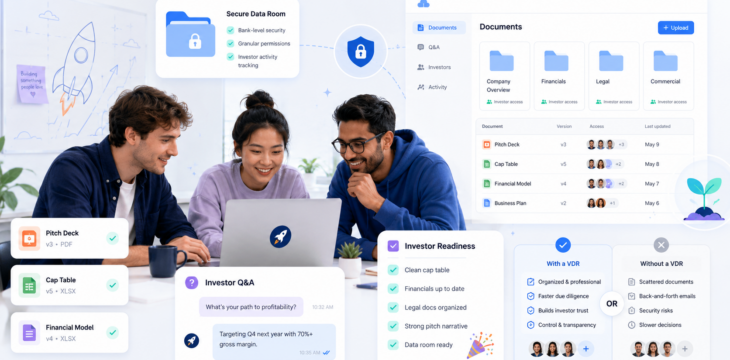
Virtual Data Room for Seed Round: Do Early-Stage Startups Really Need One
Many founders believe that a data room only matters for Series B or later companies. That belief no longer reflects…
Read more
VDR Market Explosion: 2026 Data Room Market Trends and Leading Players
Global virtual data room market size and growth trajectory The virtual data room market is exploding. Valued at USD 2.83…
Read moreStartup Data Room Checklist
A startup data room needs eight core document categories, and investors typically request the high-priority ones — company overview, cap table, financials, and IP — before anything else.
See the full downloadable version in our startup data room checklist.
Benefits of a Virtual Data Room for Startups
A virtual data room gives startups four concrete advantages over email and shared folders: it signals investor-grade professionalism, consolidates scattered documents into one source of truth, compresses due diligence from weeks to days, and turns investor silence into a measurable engagement signal.
1. Investor-grade professionalism
A clean folder structure, consistent file naming, and instant document availability tell an investor more about a founding team’s operational maturity than any slide claiming “we’re detail-oriented.” Investors who’ve sat through dozens of due diligence processes notice disorganization immediately and read it as a signal about how the company runs internally.
2. A single source of truth
A typical startup accumulates dozens of critical documents before its first real fundraising conversation — founding agreements, product roadmaps, board minutes, cap tables. Managing them across email threads and expiring share links creates real risk: a sensitive file forwarded once can’t be un-forwarded. A data room consolidates every version into one permissioned workspace.
3. Faster due diligence
Due diligence timelines are usually set by document availability, not investor interest. A properly structured data room eliminates that lag: a request for a specific contract gets answered in the time it takes to click a folder, not the time it takes to search an inbox.
4. Measurable investor engagement
A data room shows founders who opened which document, how long they spent on it, and whether they returned to it later. An investor who reopens a financial model three times in one week is showing more genuine interest than one who opened it once – a distinction invisible over email but immediately visible in data room analytics.
Compare Top VDR Providers
Visit Website
- AI-powered redaction supporting multiple file formats
- MCP support lets AI assistants like Claude work directly inside the room
Next Steps
Compare the providers ranked above, check pricing against your raise size, and test your top pick with a free trial before committing — most platforms let you upload real documents before you pay anything.
Frequently Asked Questions
A data room for a startup is a secure online workspace for sharing confidential documents with investors, advisors, or potential acquirers. It typically stores cap tables, financials, contracts, intellectual property records, and other due diligence documents, with permissions, activity tracking, and security controls that standard file-sharing tools may not provide.
The best data room for a startup depends on its fundraising stage, document volume, budget, and security requirements. For early-stage fundraising, a startup-friendly platform with fast setup, investor analytics, secure sharing, and flexible pricing is usually the best fit. Later-stage companies going through formal due diligence may need more advanced permissions, Q&A workflows, and enterprise security.
Startup data room pricing ranges from free plans and low-cost per-user options to several hundred dollars per month for dedicated virtual data rooms. The price usually depends on the number of users, documents, storage, security features, analytics, and whether the provider charges per user, per project, or a flat monthly fee.
A startup data room typically includes corporate documents, a current cap table, financial statements and projections, SAFE or convertible note agreements, material contracts, intellectual property records, employment documents, key metrics, and other legal or compliance documents. The exact checklist depends on the fundraising stage and the level of due diligence investors are conducting.
A startup does not usually need a full enterprise VDR for an early seed round, but having a secure data room ready before formal due diligence can save time and make investor document sharing much easier. A simple startup data room is often enough for a small team with a limited number of investors and documents.
Google Drive can work for early document sharing, but it does not provide all the controls typically expected from a dedicated data room. Depending on the plan, a VDR can add granular permissions, investor activity tracking, watermarking, NDA gates, download controls, link expiration, and detailed audit trails for sensitive fundraising and due diligence documents.
Important data room security features for startups include granular permissions, dynamic or viewer-specific watermarks, activity and audit logs, download and print controls, link expiration, access revocation, NDA protection, and secure authentication. The level of protection should increase as the startup moves from early fundraising into formal due diligence or M&A.
Investor engagement can be tracked through data room analytics that show who opened documents, which files or pages they viewed, how long they spent reviewing them, and whether they returned later. Page-level analytics can give founders a better indication of investor interest than simple link-open counts.
DocSend is primarily a document sharing and engagement analytics platform, although some plans include data room functionality. Whether it is a suitable virtual data room depends on the level of permissions, security controls, audit trails, and due diligence features your fundraising or transaction requires.