Top Startups to Watch in 2026

The annual startup list is usually a trap.
Too many of them confuse visibility with importance. A startup raises a giant round, lands on a conference stage, and instantly gets treated like a proxy for the future. Then six months later, the category shifts, budgets tighten, or customers fail to show up. The company may still matter, but the original story was wrong.
A better way to look at top startups in 2026 is to ask where they sit in the economy’s real pressure points. Which companies are tackling expensive bottlenecks? Which ones are getting pulled into genuine demand rather than surfing a passing trend? Which ones reveal something useful about how markets are changing?
That matters this year because startup funding has become both bigger and narrower at the same time. TechCrunch reported that global startup funding hit $297 billion in the first quarter of 2026, but more than 63% of that came from just four giant rounds. In other words, the headline market is booming, but the distribution underneath it is still selective. Founders looking at the top-line number and assuming money is flowing freely to everyone are reading the market the wrong way.
That is why the most interesting startups in 2026 are not all in one lane. Some sit inside AI, but not necessarily where the public is looking. Others are in robotics, security, climate, biotech, and financial infrastructure. What connects them is not hype. It is that each one sits close to a real operational need: building software faster, securing code earlier, moving money across borders, restoring degraded land with a finance model behind it, or bringing robots into environments that are already paying for labor substitution.
1. Lovable: from open-source experiment to one of Europe’s fastest-growing software companies

Lovable is one of the clearest examples of how quickly a side-project logic can become a commercial engine when timing is right. The company traces its roots to GPT Engineer, an open-source project built by co-founder Anton Osika. Lovable itself says GPT Engineer evolved into the product now sold as Lovable, and the company later rebranded explicitly from GPT Engineer to Lovable as it moved from developer experiment to mainstream app-building product.
The funding curve tells the rest of the story. TechCrunch reported that Lovable raised $15 million in a pre-Series A round in February 2025, then $200 million in a Series A in July 2025 at a $1.8 billion valuation, and then $330 million in a Series B in December 2025 at a $6.6 billion valuation. By April 2026, TechCrunch reported that the company was on a $400 million ARR track as of February.
What makes Lovable worth watching is not just its speed. It is the market it is helping define. The company sits in the “vibe coding” category, but that label can be misleading because it makes the product sound casual. In reality, Lovable is chasing a serious shift: software creation moving closer to product managers, operators, marketers, founders, and nontraditional builders who do not want to wait for a full engineering cycle before testing an idea.
That is also where the company becomes more interesting journalistically. Lovable is not simply selling AI-generated code. It is selling compression: less distance between concept and working product. In stronger markets, that is useful. In tighter markets, it becomes urgent. Teams want to ship more with fewer people. Early-stage founders want to validate ideas before hiring heavily. Enterprises want internal tools without building a full queue around them. Lovable’s growth suggests those pressures are no longer theoretical.
The cautionary angle matters too. Business Insider reported this week that Lovable faced scrutiny after a security flaw exposed risks around public projects and private data visibility. Lovable acknowledged a backend error and changed visibility settings. That does not erase the company’s growth, but it does sharpen the lesson for other startups: when your product spreads fast, security becomes part of the product story whether you like it or not. Growth can outrun controls. And once customers notice that gap, the narrative changes.
For founders, that is the useful takeaway. Open-source traction can absolutely become a venture-scale business, but the move from community enthusiasm to enterprise trust happens fast. That is one reason internal discipline matters much earlier than many startups expect. If you want to connect that lesson back to your own audience, this is a natural place to reference startup fundraising and startup due diligence: why 90% of startups fail it.
2. Apptronik: humanoid robotics moves out of the demo phase
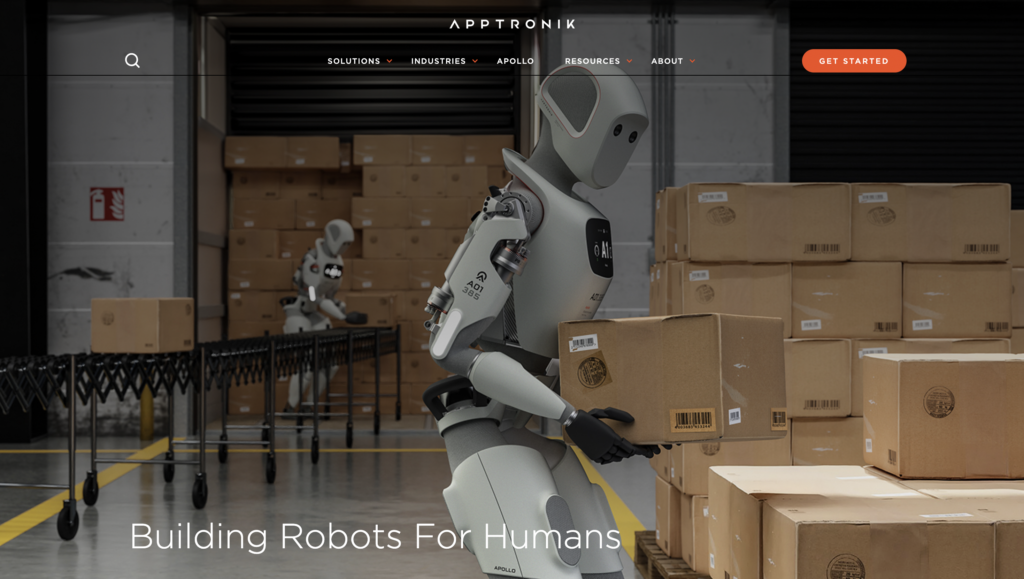
If Lovable represents software moving downmarket to more users, Apptronik represents robotics moving upmarket into real commercial buyers.
The Austin company was founded in early 2016 as a spinout from the Human Centered Robotics Lab at the University of Texas at Austin. Apptronik says so directly on its own site, and NASA’s spinoff coverage adds a revealing detail: one of the company’s earliest jobs after founding was a Small Business Innovation Research contract from NASA to develop liquid-cooled robotic actuators. That matters because it places the company’s origin not in a hype cycle but in research commercialization.
The recent funding has been enormous. Reuters reported in February 2026 that Apptronik raised $520 million in a Series A extension, bringing its valuation to around $5 billion. Reuters also noted that the company had already raised $350 million in 2025 to scale production of its Apollo humanoid robot. Commercial agreements with Mercedes-Benz and GXO Logistics were already in place, and the company planned to expand its facilities in Austin and California while pushing workforce size beyond 300 employees.
That is the central point: Apptronik is not just building a robot. It is trying to prove that humanoids can be deployed where labor shortages and repetitive tasks already justify automation budgets. Apollo is designed for manufacturing and logistics settings, and Reuters reported that it uses both legs and wheels so it can navigate industrial environments built for humans. That design choice sounds small, but it says a lot about the company’s strategy. Apptronik is not asking factories to rebuild themselves around a robot. It is trying to fit the robot into the world that already exists.
For other startups, the lesson is not “raise more money.” It is more specific: if you are building deep tech, you need a buyer story as much as a technology story. Apptronik’s advantage is that it can point to real use cases, real deployments, and a research lineage that predates the current humanoid frenzy. That gives investors and partners something more stable than spectacle.
That makes Apptronik one of the promising startups in 2026 for a simple reason. It is not asking the market to admire the technology in isolation. It is trying to prove a buyer case. For deep-tech founders, that distinction matters. A technology story can open doors. A buyer story is what keeps them open.
3. Aikido Security: a European cybersecurity startup that understood the user too well to sound like security marketing

Aikido Security is a good reminder that some of the best startup stories begin with a very unfashionable instinct: remove friction.
The Belgian company was founded in 2022. Reuters reported that by January 2026 it had raised $60 million at a $1 billion valuation, after previously raising $24 million. Aikido’s own blog confirms the $60 million Series B, and its earlier Series A announcement confirms a $17 million round in 2024. Additional reporting from Belgian deal coverage indicates that the company was initially self-funded, then raised roughly €2 million in angel convertibles in its first year and about €5 million in seed funding in 2023 before the Series A. Some of those earliest figures are not as consistently reported across primary sources, so they should be treated as directional rather than perfectly settled.
What is clear is the customer story. Reuters said Aikido’s revenue grew fivefold in the prior year and that its customer base nearly tripled, with around half its revenue coming from the United States. Customers included Niantic, Revolut, and SoundCloud. CEO Willem Delbare told Reuters that Aikido is “really meant for people who write software,” describing it as guardrails for secure code, especially in AI-assisted development.
That framing is more important than it first appears. Cybersecurity startups often sell to executives in one language and burden developers with another. Aikido’s appeal is that it seems to have understood the adoption problem early: developers will not love a product just because it is correct. They need it to be usable. In a market where AI coding tools are speeding up software creation, security products that show up too late in the process risk becoming expensive cleanup crews. Aikido is positioning itself earlier, closer to the actual act of building.
For startups outside security, the transferable lesson is strong. Many categories are full of products that solve a technical problem but ignore the workflow problem. The company that wins is often the one that understands where the friction lives for the user, not just where the vulnerability lives in the system.
4. OpenFX: stablecoins stop being a thesis and start looking like infrastructure
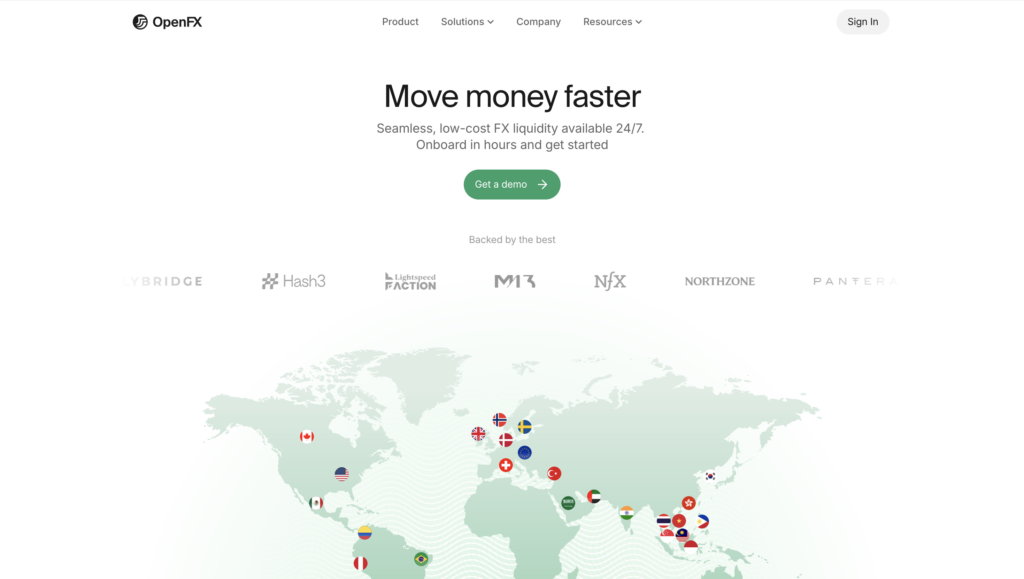
OpenFX is one of the more revealing fintech stories of 2026 because it makes a very over-discussed technology feel concrete.
Reuters reported in March that OpenFX raised $94 million, valuing the company at about $500 million. Founder Prabhakar Reddy started the company in 2024 after seeing long queues of people outside Western Union branches in Dubai. Reuters also reported that the company’s annualized payment volume grew from $4 billion to $45 billion in a year, and that more than 98% of transactions settled in under 60 minutes, versus the two-to-five business days often associated with legacy systems. OpenFX was already operating in the U.S., UK, UAE, and India and planned to expand in Southeast Asia and Latin America.
The founder background adds another layer. Money20/20’s speaker profile says Reddy previously co-founded FalconX, the digital-asset prime brokerage later valued in the billions, and earlier worked at Accel. That does not guarantee success, but it explains why OpenFX looks less like a typical crypto startup and more like infrastructure built by someone who already understands market plumbing.
That is the right way to read this company. OpenFX is not interesting because stablecoins are trendy again. It is interesting because it translates stablecoins into something CFOs and treasury teams can recognize: faster settlement, lower friction, and cross-border money movement that behaves more like software. The best fintech startups often do this. They remove ideology from the story and replace it with a practical outcome.
For founders, the lesson is simple but hard to execute: use a controversial or overhyped technology only when it helps solve a boring, expensive business problem. OpenFX is not selling crypto culture. It is selling better rails.
5. Hyper: enterprise AI gets interesting when it enters the back office
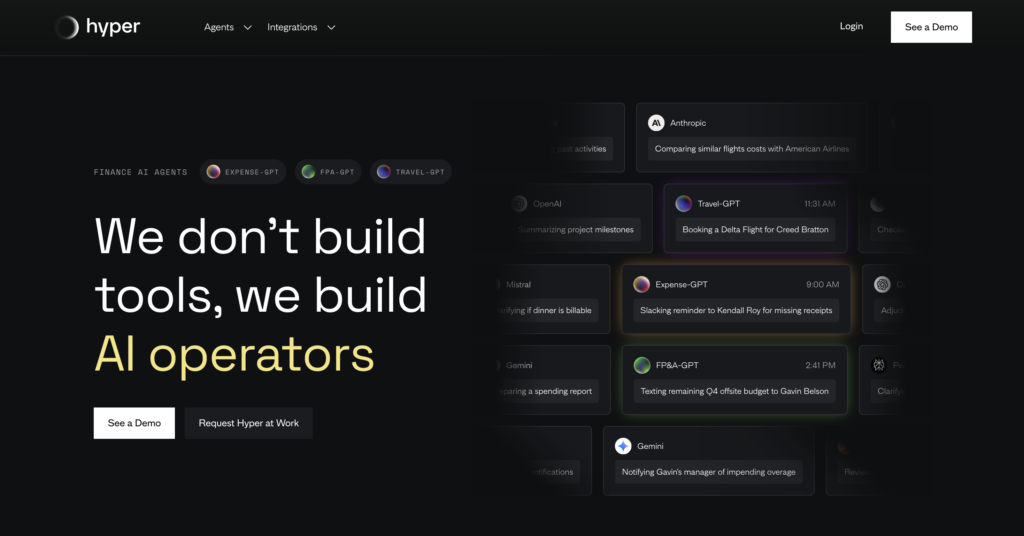
Hyper may not be the most famous startup on this list, but it may be one of the clearest signals.
Reuters reported in April that American Express agreed to acquire Hyper, a startup founded in 2022 that builds AI-powered expense-management tools. BusinessWire’s deal announcement adds that Hyper focused on turning expense management from a manual process into more autonomous workflows, while American Express said the two companies had already partnered in 2024 on a co-branded card with embedded AI-powered expense agents. Reuters did not disclose the price, and public reporting around Hyper’s earliest rounds is thinner than for some venture-backed software companies, though startup-tracker databases indicate total funding in the low teens of millions. That number should be treated cautiously unless confirmed by the company or a lead investor.
What matters more than the price is the category signal. Expense management is not glamorous. That is exactly why it is useful as a startup case study. Hyper automated categorization, policy checks, report filing, reminders, and audit-heavy back-office tasks. Those are repetitive, rules-based workflows where AI does not need to feel magical to create value. It just needs to save labor and reduce error.
That is what other startups should pay attention to. The next enterprise AI winners may not be the companies with the most dramatic demos. They may be the ones that make old, tedious processes hard to justify doing manually. Hyper’s sale to AmEx is a clue that incumbents are willing to buy that capability rather than rebuild it slowly themselves.
6. Re.green: climate tech gets more credible when it touches land, labor, and finance at the same time
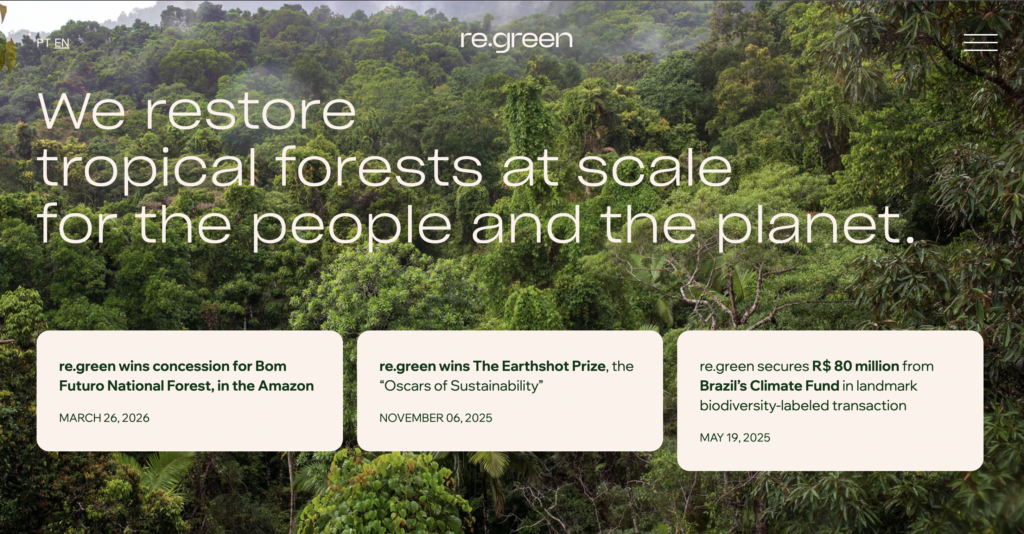
Climate startups often sound impressive before they prove anything. Re.green is more interesting because its story has started moving into harder terrain: land rights, project finance, public policy, and measurable restoration.
Reuters reported in March that Brazil awarded its first public land concession for reforestation to Re.green, giving the company rights to restore and help protect 145,000 acres in the Amazon’s Bom Futuro reserve for 40 years. The company was the sole bidder, and the structure is meant to test whether carbon-credit financing can support restoration of degraded protected areas at meaningful scale. Reuters said the startup estimated about $2 million in annual carbon-credit revenues from the concession and agreed to share 0.7% of revenue.
The company’s own materials help explain the scientific roots. Re.green says founder Bernardo Strassburg and partner Pedro Brancalion were recognized in 2022 among the most influential Brazilian scientists in the world, and Reuters reported in 2025 that the company had secured 80 million reais in financing from Brazil’s Climate Fund with Bradesco support. Reuters also noted that the startup buys degraded land or partners with landowners to replant native species, and that it is backed by investors including João Moreira Salles, Dynamo, Gávea, and supported by corporate players such as Microsoft. Earthshot’s 2025 profile adds that the company had already created more than 230 jobs and trained nearly 300 people.
That is why Re.green deserves attention. It is not just planting trees. It is trying to make forest restoration legible to financiers and governments. That is a much harder startup challenge than selling a software license, and also more revealing. The company has to build credibility across science, policy, local communities, and capital markets at once.
For founders in any sector, that is a powerful lesson. The best startups in complex industries do more than build product. They learn how to become readable to several constituencies at once.
7. Watershed: climate software matures when buyers can justify it without moral language
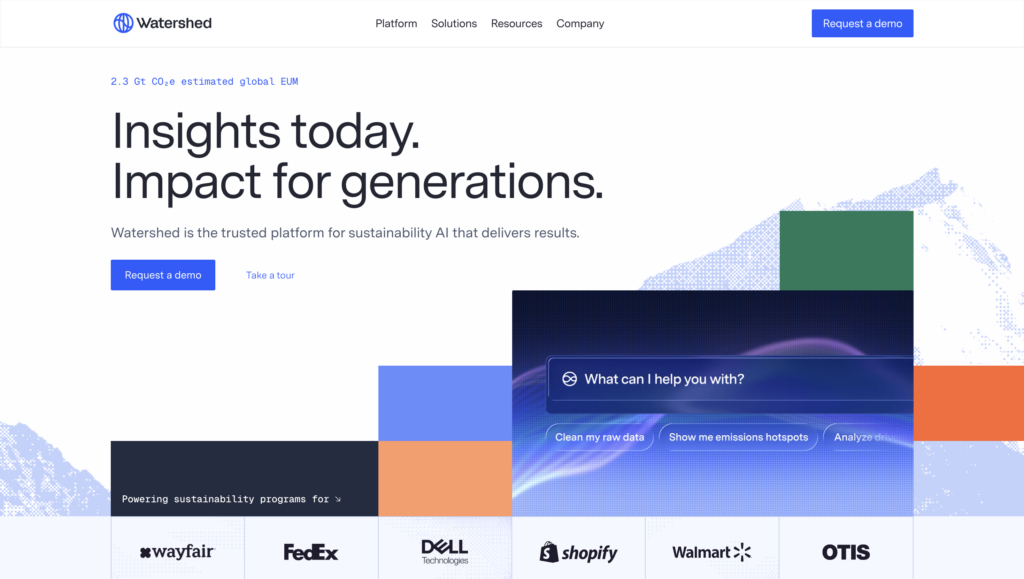
Watershed is not a 2026 newborn, but it remains one of the startups worth watching because it shows what category maturation looks like.
The company describes itself as a sustainability AI platform, and in 2024 it announced a $100 million Series C at a $1.8 billion valuation. TechCrunch has previously noted that Watershed raised $210 million overall and positioned the company as a beneficiary of corporate demand for emissions measurement and reporting, particularly around hard-to-track Scope 3 emissions. Watershed says it was founded in 2019, and Verdantix named it a leader in its 2026 Green Quadrant for enterprise carbon management software.
What makes Watershed journalistically interesting is that it sits beyond the first climate-software wave. The early pitch in this category often leaned on values. The newer pitch leans on process. Companies still argue over regulatory standards and disclosure pace, but large enterprises increasingly need internal systems to collect data, quantify emissions, manage supplier information, and make reporting less chaotic. That turns climate software from a brand-positioning tool into operational software.
The broader lesson for startups is that markets often become easier to sell into once the emotional argument cools down and the operational argument gets stronger.
What other startups should actually take from these case studies
The surface stories here are different, but the startup mechanics underneath them are surprisingly consistent.
First, several of these companies began with a clear “wedge” before they expanded. Lovable came out of a focused open-source coding project. Aikido started with security developers could actually use. Hyper attacked one dull workflow rather than trying to reinvent enterprise finance all at once. Apptronik did not start by promising robots everywhere; it focused on industrial tasks where buyers already exist.
Second, the strongest companies here are attached to a real bottleneck. OpenFX is about settlement friction. Syenta, in the earlier draft, was about chip-packaging constraints. Apptronik is about labor shortages and industrial throughput. Re.green is about financing ecological restoration in a world that increasingly needs it. Startups that attach themselves to a bottleneck are often easier to understand and harder to ignore.
Third, fast growth creates a second company inside the first one. The product company becomes a process company. That is where many startups wobble. They can win users, maybe even win revenue, but they are not ready for the scrutiny that arrives with major enterprise customers, acquirers, or later-stage investors. That is where clean internal records, contract discipline, data control, and version clarity stop being “ops work” and start becoming strategic assets.
Final take
The most interesting startups of 2026 are not necessarily the loudest startups of 2026.
They are the companies that reveal where real demand is moving. Lovable shows how quickly open-source AI tools can become a commercial product when they reduce time-to-build. Apptronik shows that robotics becomes investable when it enters paid deployments. Aikido shows that security can still feel fresh if it respects the developer. OpenFX shows that stablecoins look much more convincing when they behave like infrastructure. Hyper shows where enterprise AI is likely to create near-term value. Re.green shows that climate startups gain credibility when they operate inside finance and public systems, not just slogans. Watershed shows what happens when a once-idealistic category matures into enterprise process software.
That is a stronger way to watch startups this year: not by following the biggest valuation jump, but by following the companies that are becoming difficult for the market to route around.